Back to feed
Society
7th Overseas Chinese New Media Forum Held in Tianjin
Source: People's Daily Overseas Edition
The scene at the 7th Overseas Chinese New Media Forum (Photo: Xie Ming)
Overseas Network, October 14 — In the golden autumn on the shore of the Bohai Sea, the 7th Overseas Chinese New Media Forum opened in Tianjin on October 14. Themed “Uniting the Overseas Chinese Community and Nurturing Love for Home and Country,” it brought together more than a hundred overseas Chinese media representatives, scholars and business figures from five continents to discuss how, in the new era, overseas Chinese can serve as a bridge for telling China’s story well, and how Chinese-language media can contribute new strength to the great rejuvenation of the Chinese nation through Chinese modernization.
Chen Zhi, a member of the editorial board of People's Daily and editor-in-chief of its Overseas Edition, said in his address that Chinese-language media should further play their role in building trust and dispelling doubts and in rallying hearts and strength — uniting the overseas Chinese community, safeguarding its interests and supporting its endeavors — and show new commitment and achievement in promoting exchanges and mutual learning between Chinese and foreign civilizations. He hoped to work with overseas Chinese-language media to safeguard the roots of the nation and carry forward a patriotism bound by shared roots; to spread the soul of culture and take up the mission of the times to shape good social norms; and to build the dream of national rejuvenation together, gathering the strong synergy of many trees making a forest.
Gao Feng, a member of the Party Leadership Group and vice chairman of the All-China Federation of Returned Overseas Chinese, noted that overseas Chinese-language media and their new-media platforms span all five continents and have long been rooted overseas, making them an important force for telling China’s story and spreading China’s voice to overseas Chinese and a wider international audience. He hoped overseas Chinese-language media would hold high the banner and present the image of the leader to the world; use overseas Chinese as a bridge to tell the story of China’s practice of modernization; use culture to cultivate people and promote exchanges and mutual learning among civilizations; and sharpen their focus to raise the effectiveness of international communication, producing work that is both readable and influential, drawing more friends from abroad to come to China and understand China, and writing together a new chapter of mutual understanding and affection, shared feeling and a shared destiny.
Wang Liwen, deputy head of the Publicity Department of the Tianjin Municipal Party Committee and Party secretary and full-time vice chairman of the Tianjin Federation of Social Sciences, said Tianjin was born of the sea and prospers by the sea, and has become the largest coastal open city in northern China and an important land-sea junction of the Belt and Road Initiative. Tianjin is now striving to build a green and open port city, an innovation-driven city of science and technology, a livable city that benefits its people, and a famous cultural city that draws those near and far. He hoped overseas Chinese-language media would use their strength in “connecting China with the world and communicating with the world” to be promoters of Chinese culture, tellers of China’s story, communicators of Tianjin’s voice, and guides who lead Tianjin to the world.
At the opening ceremony, the “Luban Alumni Association” Facebook account of People's Daily Overseas Network went live. Xu Lei, general manager of the Overseas Network, said it is continuing to expand the “Luban Alumni Association” communication matrix, and that the first “Luban Workshop Mobile Classroom” will open at Tianjin Light Industry Vocational Technical College on October 15. He hoped to work with friends from all sectors to widen the circle of friends of the “Luban Alumni Association,” so that the “Luban Workshop Mobile Classroom” can carry the spark of craftsmanship to more corners of the world.
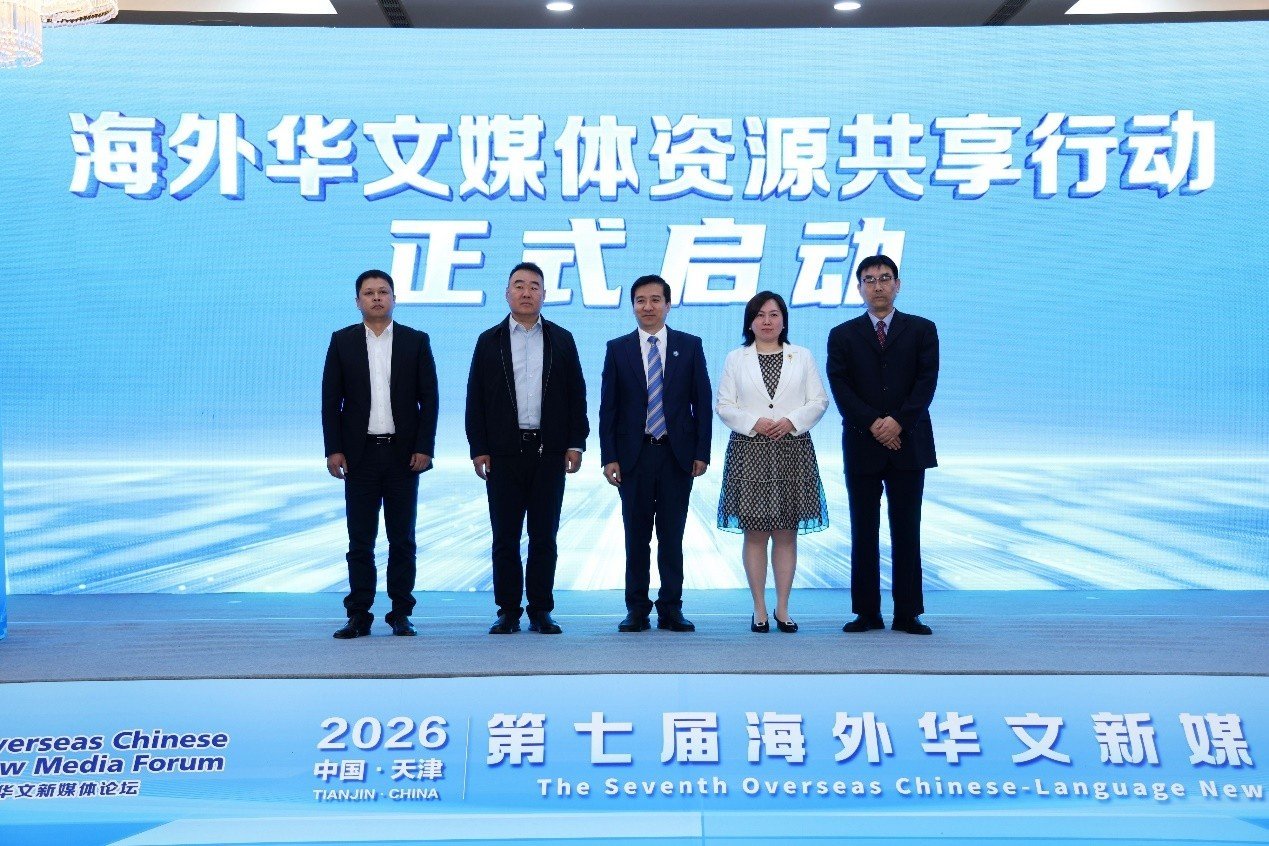
Tianjin Haihe Media Center and overseas Chinese-language media jointly launch a resource-sharing initiative (Photo: Xie Ming)
People's Daily Overseas Network and Tianjin Haihe Media Center signed a strategic cooperation agreement to set up a joint international communication practice platform, with cooperation in content-channel sharing, joint promotion of the city’s image, personnel exchanges and training, and regional and country studies. Tianjin Haihe Media Center also joined overseas Chinese-language media including Egypt’s China Weekly, Germany’s Kaiyuan Group, Canada’s Chinese News Agency and Australia’s Juao Media in launching a resource-sharing initiative, building a regular coordinated communication mechanism that helps overseas Chinese-language media get to know and report on Tianjin in depth.
In the main forum session, guests held in-depth discussions on topics including the mission of Chinese-language media in the new era, companies going global and communication going global with them, and Tianjin’s opening up. Li Zhanyong, Party secretary and chairman of the Tianjin Federation of Returned Overseas Chinese, shared the federation’s practice and explorations in serving the overall interests of the country and serving overseas Chinese. He said overseas Chinese connect the inside and outside worlds and know international rules well, and are participants, builders and promoters of China-foreign friendship and mutually beneficial cooperation; their hearts and strength must be better united so that they can do even more in Tianjin’s practice of advancing Chinese modernization.
Wu Xinghua, publisher of the Lao Chinese Times, drew on his newspaper’s experience in his keynote speech. He said overseas Chinese-language media should stay true to their positioning, use their strengths of being close to overseas Chinese communities and rooted locally, observe the times from small details, and find value in ordinary people. Taking the China-Laos Railway as an example, he said grand themes need concrete stories to carry them: Chinese-language media must explain the significance of China-Laos cooperation, and also let audiences understand through stories close to them how the cooperation between the two countries benefits ordinary people.
Shi Jingcai, deputy general manager of People's Daily Overseas Network, said in his keynote speech that China has set up more than 50,000 enterprises overseas, spread across nearly 190 countries and regions, and is moving from “products going global” to “brands going global,” which brings new opportunities for overseas Chinese-language media. The Overseas Network will draw on its strengths in brand communication, infrastructure and media alliances to help overseas Chinese-language media become more integrated, professional and platform-based, and to grow stronger together with Chinese brands going global.
Xu Fei, a member of the Party Standing Committee and deputy director of the Management Committee of Tianjin Economic-Technological Development Area (TEDA), spoke under the title “Seeing the Colors of TEDA, Sharing Opportunities of Openness,” using four colors — “gold, blue, green and colorful” — to describe TEDA’s development character. She said TEDA generates one-seventh of Tianjin’s GDP, one-quarter of its gross industrial output value, one-third of its imports and exports and one-sixth of its foreign investment. She hoped overseas Chinese-language media would come closer to TEDA, feel its “colors” and look for opportunities for cooperation.
Two sub-forums followed that afternoon. At the sub-forum “Luban Workshops: Practice and Exploration of Vocational Education Going Global,” Li Yunmei, Party secretary of Tianjin Light Industry Vocational Technical College; Kang Ning, Party secretary of Tianjin Modern Vocational Technology College; Xiaoming, a graduate of the Luban Workshop in Egypt; Weng Yue, fourth-generation heir of the Darentang pharmacy; and Yin Jie, deputy publisher of Egypt’s China Weekly, exchanged views on topics including China-Africa and China-Pakistan vocational education cooperation, the growth stories of international students, taking traditional Chinese medicine abroad, and how Chinese-language media can tell the story of the Luban Workshops. At the sub-forum “Fertile Ground of Openness, Linking New Global Opportunities,” representatives of companies including Yunsheng Intelligent, Ricky Surgical, Wangyuan Technology, UBTECH and Atom Robot discussed topics including the shift from “Made in China” to “Intelligent Manufacturing in China,” how AI is reshaping the way people produce and live, and the global picture of new quality productive forces.
On the 15th, guests will head to downtown Tianjin, the Tianjin Binhai New Area and Xiong’an in Hebei for field visits, taking in Tianjin’s historical depth and cultural charm, feeling its innovative vitality and the pulse of its opening up, and sensing the vigorous momentum of the coordinated development of Beijing, Tianjin and Hebei.
The 7th Overseas Chinese New Media Forum was hosted by the Overseas Edition of People's Daily and organized by People's Daily Overseas Network and Tianjin Haihe Media Center, with Tianjin Economic-Technological Development Area, the Tianjin International Communication Center and Tianjin Haihe Media Advertising Co., Ltd. as co-organizers. It aims to use overseas Chinese as a bridge and media as a medium to build a platform for dialogue on telling China’s story and Tianjin’s story in the new era, and to give overseas Chinese-language media new momentum to play a greater role in a globalized context.
The Overseas Chinese New Media Forum is a platform for Chinese-language new media around the world to discuss, exchange, cooperate and develop together. From 2015 to 2025 it was held six times, with guests from more than 100 countries and regions, covering 300 overseas media outlets.